
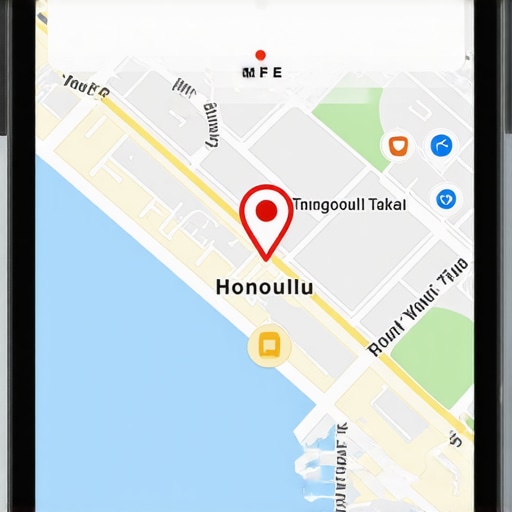
The Map Embed Tweak That Tells Google Your Honolulu Office is Legit
In the competitive landscape of Honolulu’s digital economy, the difference between a thriving storefront in Kaka’ako and a struggling business often comes down to a few pixels and a lot of invisible code. As we navigate 2026, the era of “good enough” SEO is long gone. For years, business owners believed that simply having a Google Business Profile (GBP) and throwing a standard map on their “Contact Us” page was the finish line. It wasn’t.
Today, Honolulu businesses face a “Legitimacy Crisis.” Google’s algorithm has become increasingly skeptical of “ghost offices” – virtual addresses or service-area businesses that claim a physical presence they don’t truly occupy. To combat spam, Google relies on three primary pillars: Proximity, Relevance, and Prominence. But how do you prove prominence and relevance when you’re competing against massive national chains with unlimited budgets?
My name is Boris Hrbacek, and I’ve spent years deconstructing the local algorithm. I have seen firsthand how specific technical adjustments can increase Google Business Profile visibility by over 250%. The secret isn’t just in the keywords you use; it’s in the signals of legitimacy you send. One of the most overlooked signals is what I call the “Semantic Map Embed Tweak.” This isn’t just about showing your customers where you are; it’s about telling Google’s crawlers, with mathematical certainty, that your Honolulu office is the real deal.
The “Tweak” Defined: Beyond the Standard Iframe
When most web developers add a map to a site, they go to Google Maps, click “Share,” and copy the iframe code. While this provides a visual aid for users, it does very little for your google business profile optimization. From a search engine’s perspective, a standard iframe is essentially a “black box.” The crawler knows there is a map there, but it doesn’t necessarily tie that map to your specific business entity in a way that builds ranking authority.
The “tweak” involves moving from a “lazy” embed to a “semantic” embed. This requires a two-pronged approach: using the Google Maps API to generate a map tied to your unique CID (Cluster ID) and wrapping that map in JSON-LD LocalBusiness Schema. By doing this, you aren’t just displaying a map; you are creating a data bridge between your website and your Google Maps entity.
When you rank google business profile listings using this method, you are providing Google with a “Triple-Check” of your location data. You are confirming your latitude and longitude, your Place ID, and your CID. This level of technical precision is exactly what separates the top 3 in the Map Pack from the businesses buried on page two. If you want to rank higher on google maps, you must stop thinking like a designer and start thinking like a data scientist.
Why Honolulu Businesses Face Unique Challenges
Operating a business in Hawaii presents a unique set of SEO hurdles. We are geographically isolated, yet our digital space is crowded by national mainland chains that have massive domain authority. Whether you are a boutique law firm in Downtown Honolulu or a dental practice in Waialae, you are likely being outspent by corporations based in Los Angeles or New York.
These chains often “bully” local results because their websites have millions of backlinks. However, they lack one thing: true local relevance. This is where you can win. In my guide on Honolulu SEO: 5 Ways to Outrank Huge Mainland Chains in 2026, I emphasize that local signals are your greatest weapon. Google wants to show the most relevant local result, not just the biggest brand.
The challenge is that Google’s “proximity” filter is incredibly tight in Honolulu. Because the city is dense, moving just a few blocks away from the city center can cause your rankings to crater. I’ve detailed this phenomenon in my analysis of Why Your Business Map Visibility Drops When You Leave the Honolulu City Center. To counter this, your map embed must act as a beacon of “Hyperlocal Relevance,” signaling to Google that you aren’t just “in Hawaii,” but you are a cornerstone of your specific Honolulu neighborhood.
Step-by-Step: Implementing the Semantic Map Embed
Ready to move beyond the basic iframe? Follow these steps to implement the tweak that proves your legitimacy. This process ensures your google maps seo is built on a foundation of hard data.
1. Find Your CID and Place ID
Every Google Business Profile has a unique CID. This is the “Social Security Number” of your business in Google’s database. You can find this using various local seo tools or by using a Chrome extension designed for GMB audits. Once you have your CID, you have the direct link to your business entity.
2. Generate a Map via the Google Maps Platform
Instead of the share button, use the Google Maps API (specifically the Maps Embed API). This allows you to specify your q=place_id:YOUR_PLACE_ID. This ensures that the map is explicitly tied to your verified business listing, not just a general street address.
3. Integrate JSON-LD LocalBusiness Schema
This is the most critical step. In the header or footer of your page, you need to include structured data that mirrors your map information. Your Schema should include the hasMap property, which points directly to your map URL, and the geo property, which lists your exact latitude and longitude.
Example structure:
{
 "@context": "https://schema.org",
 "@type": "LocalBusiness",
 "name": "Your Honolulu Business",
 "hasMap": "https://www.google.com/maps?cid=YOUR_CID_NUMBER",
 "geo": {
 "@type": "GeoCoordinates",
 "latitude": 21.3069,
 "longitude": -157.8583
 }
}
4. Verify with an Audit Tool
After implementation, don’t just hope it works. Use a google business profile audit tool like the ones found at SEO Viper to ensure that Google is reading your coordinates correctly. I also recommend using a google maps ranking service to track your position across different Honolulu zip codes to see the immediate impact of the change. This is what I call The Specific Local Signals That Tell Google Your Hawaii Shop Deserves the Top Spot.
The Role of NAP Consistency and Geo-Relevance
The map embed tweak is powerful, but it doesn’t exist in a vacuum. It must be supported by “NAP” consistency – Name, Address, and Phone number. If your map embed points to one address, but your website footer lists a slightly different suite number, you are creating “friction” for Google’s algorithm.
Mismatches are the silent killers of local rankings. I’ve written extensively about Why Mismatched Contact Details are Stealthily Killing Your Hawaii Map Visibility. In Honolulu, where many businesses are located in multi-story office buildings or have complex suite designations (like those in the Ala Moana Building), precision is vital. Your semantic map embed acts as the “source of truth.” When the data in your embed matches your Schema and your on-page text perfectly, Google gains the confidence to rank you higher.
Furthermore, geo-relevance involves more than just coordinates. To truly dominate the local map pack seo, your website content should mention local landmarks near your map location. If you are near the Hawaii State Capitol or the Neal S. Blaisdell Center, mention it. This “contextual proximity” reinforces the map data and proves you are a physical part of the Honolulu community.
2026 Trends: AI Map Filters and Voice Search
As we look toward the future, the way consumers find businesses is shifting. With the rise of Search Generative Experience (SGE) and AI-driven platforms like Perplexity, the “search results page” is becoming an “answer engine.” These AI models don’t just look at keywords; they look at “Entity Authority.”
When an AI filter is asked for the “best contractor in Honolulu,” it cross-references map data to ensure the business is actually operational. If your map embed is technically superior – utilizing the CID and Schema tweaks we’ve discussed – you appear as a more reliable “entity” to the AI. This is a core component of 5 Hawaii Local SEO Tactics to Beat AI Map Filters in 2026.
Additionally, voice search through devices like Alexa or Apple Intelligence relies heavily on geo-coordinates. If your site has high-quality google business profile seo, your business becomes the default answer for “near me” queries. If you’ve noticed a decline in your reach lately, it might be time to check Why Your Hawaii Maps Ranking is Dropping: 4 Fixes for 2026, as the algorithm’s reliance on technical legitimacy has never been higher.
Conclusion: The Path to the Top 3
In the world of Honolulu Local SEO, there are no “magic buttons,” but there are foundational trust signals that most of your competitors are ignoring. The “Map Embed Tweak” is one of those signals. By moving away from basic iframes and embracing semantic, data-rich embeds, you provide Google with the proof it needs to trust your business’s physical existence and relevance.
As Norsu Media Group research indicates, “A map embed isn’t a magic SEO button, but it strengthens location signals, user experience, and trust.” In a market as tight as Honolulu, where every lead counts, that strength is your competitive advantage. Whether you are looking for a comprehensive google maps ranking service or you want to DIY your optimization using a google maps rank tracker, the goal remains the same: total local dominance.
Don’t let your business be a “ghost” in the machine. Audit your map embed today, align your Schema, and claim your spot at the top of the Honolulu Map Pack. If you need a professional eye to review your strategy, reach out for a consultation – let’s make sure Google knows exactly where you stand.