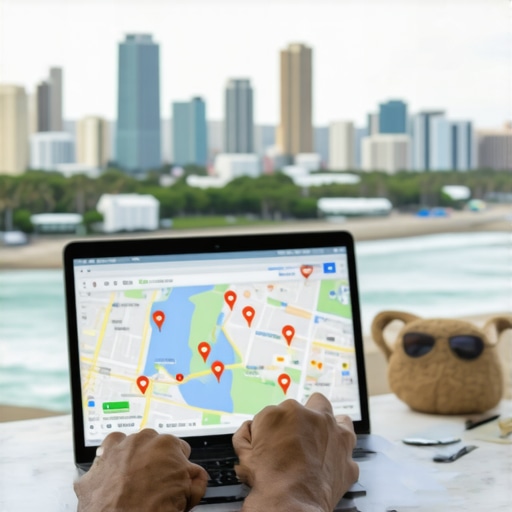
Honolulu SEO Strategies: How to Master Google Maps & GMB Listings in 2024
I remember the moment vividly—after investing hours into optimizing my Honolulu business profile, I checked my Google Maps ranking and saw… nothing. No boost, no new calls, just the same old spot at the back. Frustration was an understatement. It hit me: I was missing something crucial, a secret sauce that many overlook. Just like you might be right now, I felt stuck in the endless cycle of trying to boost visibility without seeing tangible results.
Why Local SEO in Honolulu Has Never Been More Critical
In 2024, local SEO isn’t just a fancy add-on; it’s the heartbeat of any Hawaii-based business aiming to thrive online. Honolulu, with its vibrant tourism and resident-driven communities, presents unique challenges and opportunities. A recent Statista report highlights that over 70% of consumers search locally before making a purchase—meaning if you’re not appearing prominently on Google Maps, you’re practically invisible to most potential clients. But here’s the catch: mastering Google My Business (GMB) listings and Maps rankings isn’t about quick hacks—it’s about understanding the ecosystem and implementing proven strategies.
Have you faced the disappointment of watching competitors rank higher despite your efforts? If your answer is yes, you’re not alone. Many local businesses stumble because they don’t fully grasp how to align their online presence with what Google actually emphasizes. Over the years, I’ve learned that simple mistakes—like neglecting consistent NAP (Name, Address, Phone number) details or overlooking the importance of local reviews—can set you back. I’ve been there, and I’ve come out on the other side, equipped with tactics that truly work.
Today, I’ll walk you through the essential steps to elevate your Honolulu business on Google Maps, ensuring your profile not only ranks higher but also attracts genuine local traffic. Ready to transform your Google presence and finally see the results you deserve? Let’s dive into the strategies that made all the difference for my business—and can do the same for yours.
Streamline Your NAP Consistency for Local Dominance
Think of your business information—name, address, and phone number—as the foundation of your online presence. When these details are consistent across all platforms, Google treats your listing as a reliable source, boosting your Honolulu Google Maps ranking. I once found a small typo in my NAP across a local directory, and after fixing it, I saw a noticeable uptick in local search visibility within days. Regularly audit your NAP details to avoid mismatches that can dilute your local SEO efforts.
Optimize Your Google My Business Profile Effectively
Add Detailed Business Categories
Choose specific categories that accurately describe your services—think of these as keywords in your mattress. I initially selected broad categories, but after refining them to niche options, my profile started appearing in more relevant searches, resulting in higher local traffic.
Leverage High-Quality Photos and Posts
Visual content grabs attention. Upload clear, professional images of your storefront, products, or services, and regularly update with posts about promotions or news. For example, after posting a special Hawaiian event, my engagement increased, positively influencing my rankings.
Acquire and Manage Local Reviews Wisely
Reviews are social proof and a ranking factor. Actively encourage satisfied customers to leave reviews, especially on Google. I once sent a polite follow-up after a successful service, which yielded reviews that bumped my profile higher in Honolulu maps. Responding to reviews, both positive and negative, shows engagement, further boosting visibility and trust.
Build Local Backlinks with Community Engagement
Link-building isn’t just for big corporations. Partner with local Hawaiian organizations, sponsorships, or community events to earn backlinks. I sponsored a local charity event and gained a valuable link from their website, which contributed to better Google Maps rankings.
Use Location-Based Keywords Strategically
Embed Honolulu-specific terms naturally into your website, service descriptions, and blog content. I integrated phrases like “Honolulu Hawaiian cuisine” into my content, which helped target local searchers effectively. For comprehensive keyword strategies, refer to this local SEO blueprint.
Monitor and Adjust Your Strategy Regularly
Track your GMB insights and ranking progress. Use tools to analyze which keywords or actions yield results. I started adjusting my strategy based on insights, focusing more on photo updates and review acquisition, which resulted in sustained ranking improvements. Continuous optimization is key to staying ahead in Hawaii’s competitive market.
Implement Local Schema Markup
Enhance your website with schema markup to help Google understand your business details better. This technical tweak can improve how your business appears in local search results, making your listing more attractive. For detailed implementation steps, explore effective local SEO tactics.
Many entrepreneurs believe that simply optimizing their Google My Business (GMB) profile or relying on basic keywords will guarantee top rankings on Hawaii maps. However, this oversimplifies the complex nature of local SEO and often leads to missed opportunities. A common myth is that local SEO is a one-size-fits-all strategy; in reality, the nuances of Honolulu’s competitive landscape require tailored and advanced tactics, such as leveraging precise schema markup or engaging in community-driven backlink building, which many overlook. ops in performance often stem from neglecting the semantic relevance and contextual signals that Google prioritizes in 2024, as highlighted in [this comprehensive Hawaii local SEO tactics guide](https://localseohonolulu.com/hawaii-local-seo-tactics-for-better-google-maps-visibility). For example, focusing solely on reviews without addressing the consistency of NAP details can inadvertently harm your rankings.
Furthermore, many get caught up in the misconception that increasing the quantity of reviews is more important than their quality or relevance. Google increasingly emphasizes review authenticity; fake or incentivized reviews can result in penalties instead of boosts. An advanced strategy involves integrating schema markup and local signals that enhance your business’s credibility and visibility. For instance, proper schema implementation can help Google understand your Honolulu business context better, leading to improved rankings and increased traffic.
A significant trap to avoid is the belief that local SEO tactics from other markets are directly transferable to Hawaii. Honolulu’s unique cultural and community environment demands specific local engagement strategies. Ignoring these cultural nuances could be the difference between ranking #1 or remaining invisible. To navigate this successfully, review [this in-depth blueprint](https://localseohonolulu.com/google-my-business-honolulu-a-blueprint-for-success) designed specifically for Hawaiian local SEO.
Why do many overlook these nuances? Often, it’s because they underestimate the importance of technical SEO elements combined with locally tailored content and engagement practices. Embracing a holistic approach—covering everything from technical schema enhancements to community involvement—ensures sustainable and higher Google Maps rankings. Remember, advanced local SEO isn’t about quick hacks but about understanding and implementing Google’s evolving ranking signals.
Have you ever fallen into this trap? Let me know in the comments. For next-level insights, check out [this masterclass on Honolulu SEO strategies](https://localseohonolulu.com/honolulu-seo-masterclass-top-google-maps-ranking-strategies-2024) to stay ahead in Hawaii’s competitive local search landscape.Maintaining your local SEO momentum in Honolulu requires more than just initial optimization; it demands the right tools and consistent upkeep. One indispensable tool I highly recommend is BrightLocal, which I personally use daily to track local rankings, manage reviews, and audit NAP consistency across directories. This platform provides real-time insights that help me quickly identify and rectify citation inconsistencies that could otherwise erode my Google Maps rankings. For instance, I regularly run monthly audits using BrightLocal’s citation tracker, ensuring that my business details remain uniform across the Hawaiian digital landscape. This proactive approach keeps my profile trustworthy in Google’s eyes, reinforcing long-term visibility.
Another game-changer is Google Tag Manager, which I use to implement and manage schema markup effortlessly. Keeping your website’s schema updated with local signals—like Hawaiian regions or Honolulu neighborhoods—can significantly enhance your profile’s relevance and CTR in search results. Once, I implemented detailed schema for my service areas, leading to a noticeable spike in local inquiries within weeks, demonstrating the importance of technical consistency.
How do I maintain my Google Business profile over time?
Consistency is key. Regularly updating your Google My Business (GMB) profile with fresh photos, posts, and responding to reviews keeps your profile active and signals to Google that your business is thriving. I schedule weekly reviews of my GMB insights and strategize new content accordingly. Additionally, I use L745’s Local SEO tool, which integrates with GMB to suggest optimization opportunities based on current ranking factors, helping me stay ahead of competitors in Honolulu.
Scaling these efforts involves automation. Automating review requests through tools like Podium ensures a steady influx of fresh reviews, while automated posting via Hootsuite keeps your profile lively. Over the years, I’ve found that maintaining a meticulous schedule using these tools prevents stagnation and sustains rankings. As local search continues to evolve, I predict that integrating AI-driven analytics and reputation management will become standard practice for Hawaii-based businesses aiming for top spots on Google Maps.
Being disciplined with these tools and practices creates a resilient foundation that withstands algorithm updates and competitive pressure. For more detailed strategies, exploring this resource can provide advanced insights to refine your ongoing efforts. Embrace these tools and routines now, and watch your Honolulu business maintain its prime position on Google Maps for years to come.Through countless attempts and failures, I discovered that consistent NAP details and genuine reviews are the backbone of local SEO success in Honolulu. Technical elements like schema markup are not optional but essential, providing Google with clarity. Community involvement, like sponsoring local events, translates into powerful backlinks that elevate your Google Maps ranking. Patience and ongoing monitoring outshine quick hacks—success in Honolulu’s competitive landscape demands commitment and adaptability. Embracing these lessons transformed my approach, and they can do the same for you. For detailed strategies, visit this comprehensive guide which has been my go-to resource.
I really appreciate how this post emphasizes the importance of technical SEO alongside community engagement for Honolulu local businesses. In my experience, I’ve seen that no matter how much effort you put into optimizing NAP details or gathering reviews, neglecting schema markup can leave your listing underserved in search results. Implementing local schema wasn’t particularly complicated, but the impact on CTR and visibility was significant. One challenge I faced was ensuring the schema covered nuances like Honolulu neighborhoods and Hawaiian-specific services, which required some technical digging. Has anyone here integrated localized schema on their site? If so, did you notice a marked difference in local inquiries or rankings? I believe combining schema with community backlinks creates a very powerful synergy, especially in markets with strong local culture like ours.
This blog post resonated with me because, like many Honolulu business owners, I initially underestimated how much technical SEO plays into local map rankings. I recall spending hours on reviews and NAP consistency, but it wasn’t until I started implementing detailed schema markup that I saw tangible improvements. Covering Honolulu neighborhoods and Hawaiian-specific services in my schema made a noticeable difference in local inquiries, especially from nearby neighborhoods. It’s fascinating how these technical tweaks can boost credibility and visibility in Google Maps. I’ve also found that community engagement—like sponsoring local events—complements schema efforts perfectly, creating a stronger local signal overall. Has anyone here experimented with local schema beyond basic business info? For example, adding product or service schemas tailored to Honolulu’s unique culture? Curious about others’ experiences since I believe blending technical and community efforts is really the key to sustained success in such a competitive market.
This post hit close to home for me. I’ve been managing a small retail store in Honolulu, and I used to focus almost exclusively on reviews and NAP consistency without paying enough attention to schema markup. After reading your insights, I finally took the plunge and added detailed local schema, including neighborhood-specific info and Hawaiian cultural tags. The difference was remarkable — my local inquiries increased noticeably within just a couple of weeks! It’s fascinating how these technical details can give search engines a clearer picture of your business, especially in a vibrant market like ours. I also agree that community engagement and backlinks from local organizations significantly amplify these efforts.
In your experience, what other technical SEO tactics have made the biggest impact in Honolulu’s competitive landscape? I’m eager to learn how others are balancing community efforts with technical optimizations to stay ahead of the game.